
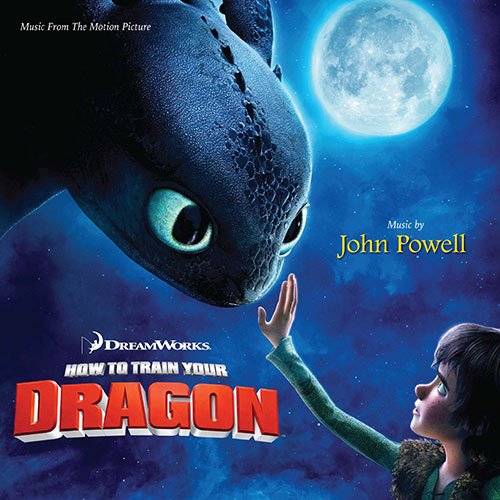
HOW TO TRAIN YOUR DRAGON has an awkward title, but its problems end there. A rousing score by John Powell, beautiful 3D animation, and a moving story create one of the best animated films I’ve seen outside of the Pixar lineup, and by far the best effort by Dreamworks. By eschewing the studio’s penchant for annoying pop culture references, the film instead allows the characters to tell the story instead of cramming the screen full of junky images and “hip” annoying critters in constant motion. The film has beauty, wit, and heart, and it positively soars on the wings of Powell’s score.
The Celtic influences provide flavor rather than define the music. The Norwegian Hardanger fiddle gives a rustic feel to solo lines, while the pennywhistle and dulcimer subtly add to Celtic feel, without overwhelming the power of Powell’s music. And let’s not forget the 14 musicians (!) listed in the liner notes crying out their warpipes.
“This Is Berk” starts off the film and the album with a bang. Powell weaves together multiple themes among some brisk action writing, including those for the dragons, the Vikings, Hiccup’s heroic theme, and a sweeping string love theme for Astrid.
When fighting dragons is your primary occupation, you need some strong action cues to inspire you. And Powell gives us those cues in spades. Tracks like “Dragon Battle,” “Dragon Training,” “Focus, Hiccup!,” and “Battling the Green Death” carry enough brisk tempos, belching brass, and martial percussion licks to get your blood pumping.
The music serves as the guiding force behind numerous major set pieces in the film, and it is those sequences in which Powell truly gets to shine. “Forbidden Friendship” features a gently pulsating marimba background and wordless chorus as Hiccup and Toothless forge their budding relationship. “See You Tomorrow” uses a jig to underscore Hiccup’s montage sequence as he builds a half-fin for Toothless’ tail. The cue bubbles over with joy as the boy finally comes into his own.
The flying sequences are some of the most memorable moments in the film, and Powell makes the most of them. From the pulsing excitement of Hiccup’s “Test Drive” to the tender beauty of Hiccup and Astrid’s “Romantic Flight,” Powell’s music soars across the sky and our hearts soar right along with it.
My favorite cue on the album is somewhat obscured in the film behind sound effects, though it’s still effective, especially if you know what to listen for. As Hiccup and Astrid ride Toothless into the “Dragon’s Den,” Powell creates a tension-filled 72-second crescendo. Ostinato rhythmic and melodic motifs build sequentially until a rumbling timpani roll leads us into the unexpected. Rather than unleashing the orchestral cacophony that the music led me to believe was coming, Powell gives us elongated string and brass notes instead as we see the otherworldly sight of the den swarming with dragon wings. The cue closes with a brief flash of 16th-note danger as we meet the frightening dragon queen.
This score has been in near constant play since I bought it a couple of weeks ago, and it doesn’t show any signs of being replaced anytime soon. But as wonderful a listening experience as the CD provides, the score functions even better in the film. While you’ll obviously miss some of the nuances that can only come from listening to an isolated score, the music complements the visuals and highlights the action, excitement, and emotion of the story.
HOW TO TRAIN YOUR DRAGON is a big, bold, full-bodied orchestral score that deserves all the attention it is getting. Don’t dismiss this as a Mickey-Mousing animated score. This is energetic, emotional film music at its best. Five pints raised for John Powell!
