
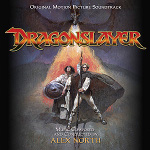
A dragon of a very different color is on display in Alex North‘s 1981 score for DRAGONSLAYER. Peter MacNicol stars as young sorcerer’s apprentice Galen, who must slay the dragon Vermithrax in order to save Valerian (Caitlin Clarke) and her village from extinction.
This Paramount-Disney co-production didn’t exactly set the box office on fire (pardon the pun). With a PG rating and discussions of virginity, parents of the tykes who might have fallen for a fantasy film about a fire-breathing dragon were put off by the film’s dark medieval setting. DRAGONSLAYER is a film like no other fantasy film I’ve seen and North’s score is unlike any fantasy score I’ve heard-dark and dissonant, yet haunting and beautiful in its own right.
According to North, “Except for the relationship between Galen and Valerian everything was impersonal. This allowed me complete freedom to compose set pieces (i.e., scherzo, rondo, et al.), such as I might do when composing for the concert hall.” North uses Gregorian chant-like harmonies based on fourths and fifths to suggest the medieval setting of the tale. He also was able to rework certain cues from his rejected score for 2001: A SPACE ODYSSEY, most noticeably at the end of the film.
The orchestrations by Henry Brant (North’s orchestrator on CLEOPATRA and himself an avant garde, Pulitzer Prize-winning concert composer) feature unusual instrumentation, including log drums, harpsichord, contrabass clarinets, baritone and bass oboe, six piccolos, and a contrabass trombone, euphonium, and Wagner tuba to convey the menacing low brass four-note theme for the dragon.
North has always been known for his contrapuntal writing and DRAGONSLAYER contains some of his best. Melodic fragments are foreshadowed and weave in and out of the contrapuntal lines. But the dissonance is the star of the score.
By the time we get to the love theme for Galen and Valerian, it’s like a breath of fresh, albeit brief, tonal air. The theme, which starts in the clarinet before moving to the oboe and the strings, is beautiful without being sentimental, subtle without being schmaltzy.
But DRAGONSLAYER is not all doom and gloom. The jaunty humor of the “Forest Romp” has a tonal center that never stays in one place for very long, but the rhythms stay within more traditionally recognizable meters than most of the rest of the music. The score also features brave musical choices like the anachronistic waltz of the “Burning Village” and “Dragon Sore-ing.” I can’t imagine a producer or director today who would let a composer, not even one of North’s legendary stature, get away with something like this.

I’ve admired this score ever since I bought the box set LP in the early 1980s. I probably never would have seen the film or purchased the soundtrack had North not received a surprising, yet well deserved, Oscar nomination for the score. But I never knew until I got this superb La-La Land release that my old CD (that I paid a small fortune for back in the day) was a bootleg all along. No matter.
If you’re familiar with the old LP or CD versions, this release is a revelation. Producer Dan Goldwasser has done a superb job in realizing the score. It feels and sounds just as fresh as it did nearly 30 years ago, which no doubt has helped the film to stay fresh as well. Jeff Bond’s liner notes provide great insight into the film and the score. Visit the La-La Land site to hear more sound clips and to order.
As with most Alex North scores, DRAGONSLAYER can be a tough listen for those who prefer their scores more tonally based. However, it provides riches for those who are willing to give it the chance. North’s atonal approach to the score was the perfect complement to the stark visuals onscreen and another masterpiece from this legendary composer.