
James Horner is not a hack. You don’t work your way up to the top level of film composers without talent. And Horner has immense talent. Perhaps that is why he is often the target of vehement attacks by film score fans. Perhaps it is his notorious practice of self-borrowing. Whatever the reason(s), film score fans love to bash Horner.
I have great affection for many of Horner’s scores-in particular APOLLO 13, FIELD OF DREAMS, and SEARCHING FOR BOBBY FISCHER. But no score in recent memory has been so eagerly anticipated as Horner’s efforts on AVATAR, his latest collaboration with director James Cameron. The two had previously collaborated on ALIENS and TITANIC. AVATAR occupied a year and a half of Horner’s life, no doubt due to Cameron’s notorious editing and re-editing of his film. With all the attention surrounding Cameron’s revolutionary filmmaking techniques (and they are something to behold), it’s a shame that Horner’s accompanying score is so pedestrian.
Horner has said in interviews that he didn’t want the music to “put something in front of [audiences] that’s light years ahead and expect them to accept it…mainstream audiences [are] not ready for an avant garde experience — they don’t listen to avant garde music and Avatar is not an art film. The score needed to be grounded; that’s where the world’s ear is.” I accept that and appreciate that. What I don’t accept or appreciate is a score that sounds like a mashup of nearly every major Horner score that came before it.
The first few notes and harmonies of the love theme are reminiscent of the main love theme from TITANIC. The long, flowing melody veers off into its own territory, but once those notes are cemented in your ear, it’s difficult to remove the earlier association. We first hear the theme as paraplegic Jake (Sam Worthington) inhabits his avatar body and goes running through the native grasses of Pandora. The running accompaniment sounds an awful lot like figures from earlier scores such as A BEAUTIFUL MIND and SEARCHING FOR BOBBY FISCHER.
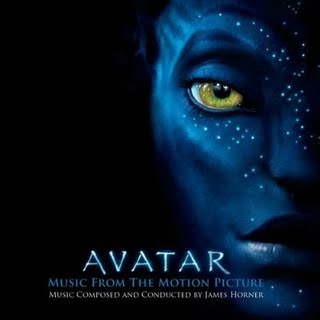
Fans of Horner’s work will recognize the beginning of the second main theme as a major theme from his 1989 score for GLORY. But even that was not original. That theme was borrowed from Prokofiev’s 1948 score for IVAN THE TERRIBLE. Again, the earlier associations are hard to ignore, especially when it is continually used in the chorus. Though this theme also veers off into its own territory, I expected something more novel for this alien world from both of these themes.
Horner also talks about the “tremendous amount of colour” used in the score, “colours that we haven’t heard before.” Really? Recorder? Heard it in BRAVEHEART. Chanting natives and wailing women? Heard them in APOCALYPTO. The snare drum motif? ALIENS. That three-note “danger motif” that only film score geeks will recognize? That goes all the way back to STAR TREK II: THE WRATH OF KHAN. Even the two main themes aren’t entirely original.
You could argue that all of these elements add up to the culminating score of Horner’s career so far. For me, the similarities and outright borrowing from earlier scores is a major distraction, while the rest of the score is ultimately much ado about nothing.
The jungle rhythms and percussion often sound electronically enhanced and synthesized. That may create a steady beat for the orchestra to play to, but it also robs those segments of any semblance of acoustic life.
The brass, vocals, and percussion finally get a chance to show their mettle in militaristic cues like “Quaritch” and “War.” Every musician-vocal and instrumental-works overtime to generate excitement. But the music rambles on-at least on CD-with no semblance of direction.
Horner’s score within the film is not a hindrance, but it’s seldom an asset either. Not once did the music convey any emotion or give me any additional insight into the characters or the situations. Instead, I kept hearing TITANIC and GLORY every single time those two main themes played onscreen. To his credit, Cameron allows the music to shine in spots. But if the score works in the film at all, as it does in Jake’s first flight and a couple of other scenes, it speaks more to Cameron’s visuals and Worthington and Zoe Saldana’s performances than Horner’s music.
By the end of the film, I stopped expecting anything spectacular from the aural landscape that Horner had “created.” Horner had spent the better part of 2 hours and 40 minutes creating a sonic world, for better or worse, for Cameron’s enticing visuals and the music was what it was. But that slender musical spell is shattered immediately with the film’s final blackout and the end credits roll accompanied by the execrable pop song, “I See You,” sung by Leona Lewis. Based on the love theme, the song follows the same formulaic structure as TITANIC’s “My Heart Will Go On,” but without the pathos and poignancy that the original song had. This pure pop drivel is nothing more than a shameless plug for Oscar attention and possible marketing value on YouTube. But it’s late-90’s sound ruins whatever precarious sonic world Horner had flimsily accomplished.
As to be expected, the orchestral and vocal elements give an excellent performance of the score. And Horner and his engineers certainly know what they’re doing in the sound booth. But the tracks on the CD do nothing to enhance the listening experience and one track sounds much the same as the next.
Most audiences wouldn’t be able to identify, much less care about, Horner’s self-plagiarism even if you told them, nor should they. But that doesn’t mean it should be swept under the rug. In a film that prides itself on new technology and a brand new world, it is not unreasonable to expect that the score supports that world. I understand that Horner didn’t want to necessarily rock the musical boat harmonically and instrumentally. But it’s a shame that the result of 18 month’s of work has resulted in something so completely unmemorable, unremarkable, and largely unoriginal. There is no denying the compositional craft on display, but Cameron’s visuals deserved better.
The disappointment generated by the AVATAR score is out of this world.